
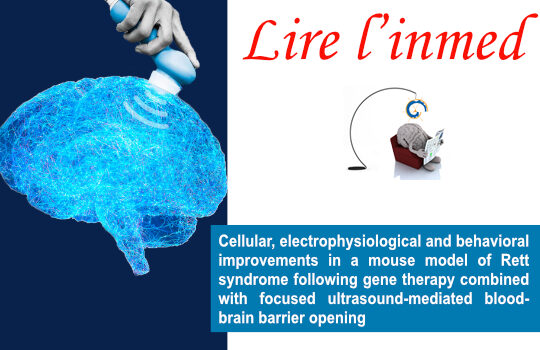
A new wave of hope. Gene therapy is one of the most promising strategies for Rett syndrome, as restoring Mecp2 expression can reverse several disease manifestations in mice. Here, the authors combine gene therapy with focused ultrasound to transiently open the blood-brain barrier and deliver the therapeutic vector to targeted brain regions. The results show improvements in neural function, plasticity, and behavior. The next challenge will be to precisely control Mecp2 expression at physiological levels.
Scientific abstract: Rett syndrome (RTT) is a severe X-linked neurodevelopmental disorder due to pathogenic variants in the methyl CpG binding protein 2 gene (MECP2). The discovery that deficits resulting from Mecp2 loss are reversible in mice has increased interest in gene therapy as a potential cure for RTT. We have previously evaluated the efficacy of a self-complementary AAV9 vector expressing a codon-optimized version of Mecp2 (scAAV9-MCO) delivered via a systemic approach in early symptomatic Mecp2-knock-out male (KO) mice. In the present study, focused ultrasound (FUS) was used to transiently disrupt the blood–brain barrier (BBB) in a RTT mouse model, thereby facilitating enhanced AAV delivery to the central nervous system (CNS). Our findings demonstrate that scAAV9-MCO administration, when combined with FUS, significantly improves survival, body weight, respiratory function, and locomotor activity, while restoring the excitatory–inhibitory synaptic balance in hippocampal neurons in treated KO mice relative to untreated animals. Quantification of the brain infection level revealed that 20–40% of cells are Mecp2-positive in the brain of KO mice following the treatment with scAAV9-MCO and FUS. This is a significant improvement compared to prior results without FUS. The evaluation of the protein levels indicates a possible overdose of Mecp2 protein in the brain cells. Nevertheless, these results demonstrate that using FUS following systemic administration of an AAV9 vector represents a significant improvement over classical gene therapy protocol for RTT.
Authors: MS Felix, L Bourcin, E Borloz, K Metwally, B Larrat, S Mensah,Y Belaidouni, JL Gaiarsa, A Novell, L Villard & JC Roux
Published in Experimental Neurology, 2026